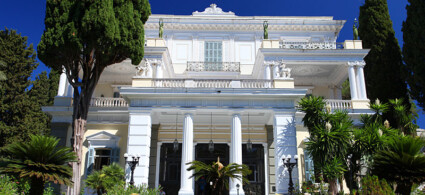
Achilleion
The Achilleion is a summer palace built in 1890 for Princess Sissi. Today transformed into a museum, the palace is located approximately 10 km from Corfu Town.
Read more
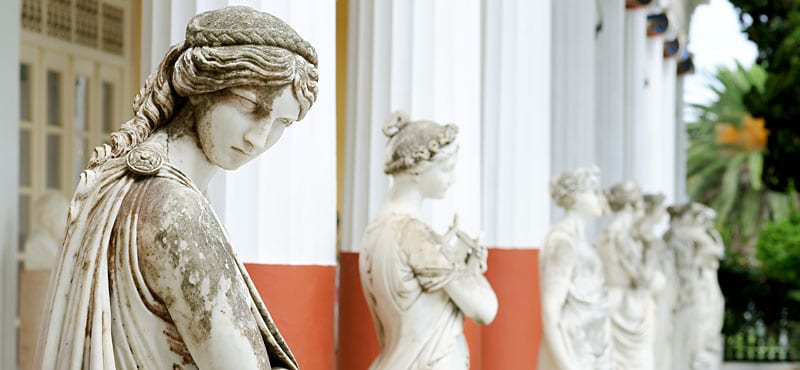
The island of Corfu and particularly its capital, which has been listed as a UNESCO World Heritage cultural monument since summer 2007, is an open-air museum. Beyond that, the turbulent history, marked by invasions and conquests, along with the culture and traditions, are expertly collected and presented within Corfu’s museums.
In Corfu Town‘s historic centre, you’ll find important museum exhibitions right next to the two fortresses that dominate the city, amongst many other historic buildings. The richest historical collection is housed in the Archaeological Museum, where you can admire artefacts from the Temple of Artemis, a Doric structure dating back to 580 BC and discovered during the Napoleonic Wars. In its day, it was one of the most imposing temples, featuring two rows of 8 columns at the front and back, and two rows of seventeen columns each along the longer sides. The Temple of Artemis in Corfu and the Parthenon are the only two Greek temples with two rows of eight columns supporting the entablature.
Corfu is also home to the Museum of Asian Art, founded in 1927, the only one of its kind in Greece and among Europe’s finest. Housed in the Palace of Saints Michael and George, a neoclassical building constructed between 1819 and 1824 that represents the most important monument of British rule. The east and west wings of the first floor house the Museum and contain more than 11,000 pieces, including terracotta and bronze vessels, Buddha statues, ceramics and Japanese artwork. In a separate section is the Corfu Art Gallery, which showcases works from the 19th and 20th centuries by Corfiot painters and sculptors.
 Hotel
Hotel  Budget accommodations
  Apartments
  Family Hotel
  Luxury Hotel
  Resorts